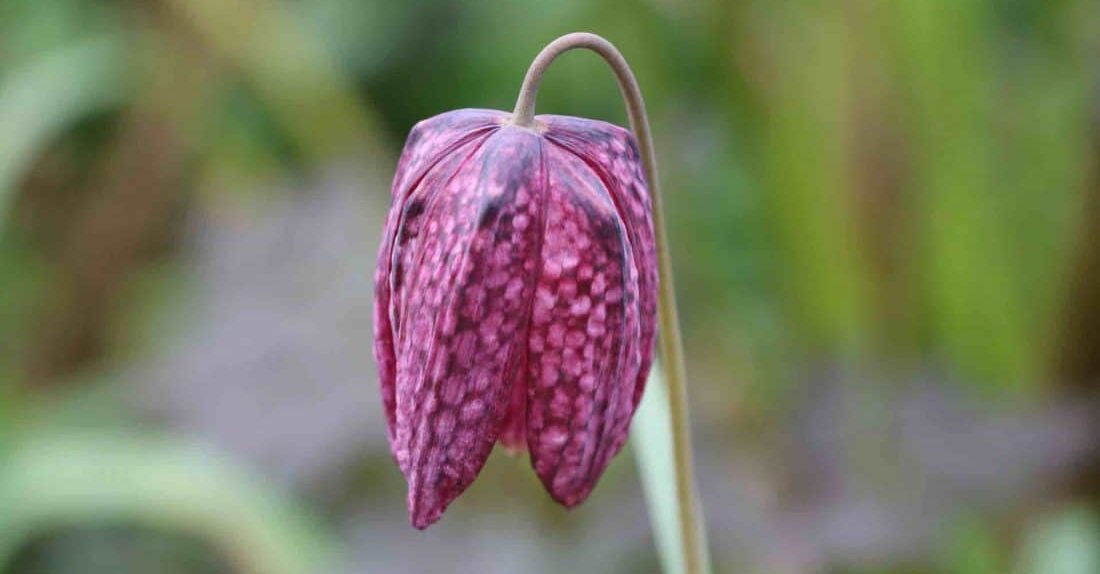
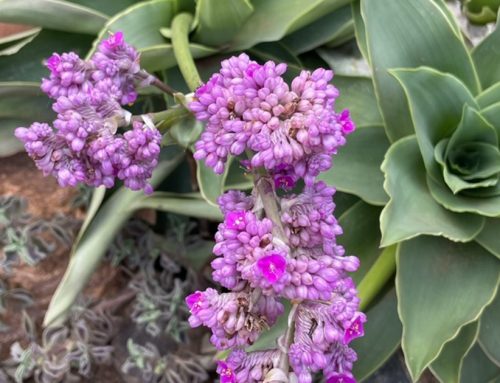
These classy bulbs deserve a place in everyone’s garden, whether naturalised in grass, planted in a border or grown in a large container – and they’re great for bees too. Despite looking delicate and vulnerable snake’s head fritillaries – Fritillaria meleagris – are robust enough to thrive in all but the most exposed locations.
It’s hard to describe the colour and pattern on the petals of these beautiful flowers which grow ‘wild’ in a few meadowland locations in the UK. And the luminosity of the blooms on a sunny spring day makes them appear like mini lampshades, lit from the inside. They also appear in a creamy white form and are surprisingly easy to establish in the garden if conditions are right, where they will start to set seed and multiply. And flowering as they do in mid spring, they are a great favourite with bees and other insect life.
Where to plant snake’s head fritillaries
These bulbs look great when grown in the light dappled shade of birch trees or naturalised in longish lawn grass. They are also ideal for planting at he front of a border in combination with other spring flowers, as well as amongst late summer perennials where they can flower and grow before the later plants take over. The fritillaries will die back in midsummer to return the following spring.
I love the combination of the dusky purplish blooms with pale yellow primroses and miniature narcissi, both of which create a wonderful colour contrast. A few bulbs planted in my garden about 6 years ago has turned into a thriving little colony. They readily set seed and you’ll generally get a mix of the different coloured forms popping up, even if you only planted one colour. The white flowered form is really luminous in the spring evening light, when the dark plum form disappears into the shade.
HEIGHT: 30cm (12in.)
These dimensions refer to the ultimate height and spread that you can expect shrubs or trees to reach in 10 years with moderate pruning. Some woody plants may be maintained at a smaller overall size – for example, cutting coloured-stemmed dogwoods or willows back hard each year. Fruit trees and bushes may also be controlled in size by pruning.
For herbaceous perennials, the dimensions represent the height and spread reached in 5 years. Remember that these plants will usually reach their maximum height in the first couple of years, but may spread more slowly. In addition these plants do not produce woody growth and taller sorts will often be cut down at the end of the winter. This category also includes spring and summer bulbs.
With annuals and biennials, the dimensions refer to the height and spread in their lifetime – either a single growing season (annuals) or spanning two growing seasons (biennials).
SPREAD: 10cm (4in.)
SOIL: Clay, loam or chalky soils, acid, neutral or alkaline soils. Moisture-retentive, but free-drained.
The type of soil in your garden will determine which plants you can grow. At the most basic level, soils vary according to their acidity or alkalinity (pH), and their texture/structure/parent material. Soils of pH6.5 can grow the widest range of plants, while loam soils that are composed of different soil particles – clay, silt and sand – are reckoned to be the best type of soil for gardening.
In the UK and Ireland, most soils vary between pH3 and pH8
Very acidic soils: pH3 to pH4.9
Acidic soil: pH5 to pH5.9
Moderately acidic to neutral soil: pH6 to pH7
Alkaline soil (limey) pH7.1 to pH8
Heavy soils usually contain small mineral particles
Clayey soils are densest and therefore heaviest, based on very small particles of clay. They can be poorly drained and lacking in air, especially if compacted.
Silty soils are composed of fine, river-smoothed particles that pack together closely and can be prone to compaction or being washed away.
Light soils are composed of larger particles
Sandy soils have larger particles in a range of sizes which prevents them being packed together and thus leaves them open to aeration and freely drained.
Peaty soils tend to be almost exclusively based on the weathered organic remains of mosses or sedges. They are usually dark in colour and fibrous.
Chalky/limey soils are usually pale in colour with visible lumps of chalk and flinty pebbles.
ASPECT: Full sun, part or dappled shade. Any location.
This is an indication of the amount of light that a particular plant requires in order to thrive, as well as suitable orientations in which it can face.
Light levels are usually listed in the following range:
Full sun – site with full sunlight for at least 10 hours in summer and 6 hours in winter, with overhanging branches and foliage of other plants.
Part shade – position that is shaded for part of the day by a structure or natural feature, usually getting sun for 5-6 hours in summer and preferably a few hours in winter.
Dappled shade – where direct sun is partly blocked by the foliage of trees, shrubs or other plants that lose their leaves in autumn. Although reduced, dappled shade is often at a consistent level through the day.
Full shade – little or no direct sunlight but usually with diffuse, ambient daylight. Such shade may be found in a courtyard enclosed on all sides.
Deep shade – The lowest light levels, found at the base of a shaded wall or under the dense canopy of an evergreen tree or shrub.
Orientation is normally listed as follows:
North-facing (between NW and NE). Low, but steady light levels and temperatures throughout the year, although exposed to cold, northerly winds. May receive direct sunlight in early morning or late afternoon during summer.
East-facing (between NE and SE). High light levels and temperatures in morning – which can be a problem after a winter or spring frost. Exposure to potentially cold and dry east winds and high temperature fluctuations.
South-facing (between SE and SW) Potential to receive high light levels and tempertures all year round. Can be very hot and dry in summer, but affords useful shelter from the worst of the cold in winter.
West-facing (between SW and NW) Usually the mildest orientation with high light levels and temperatures in the afternoon. Protection from coldest easterly and due northerly winds in winter and spring.
HARDINESS: Hardy down to -15C
The Royal Horticultural Society lists graded RHS hardiness ratings for plants from H1 to H7, but in a simpler form, most garden plants can be identified as follows:
Tender – can’t survive frost and requires temperatures above 1 Celsius to thrive. Best brought under cover in winter.
Half-hardy – tolerant of short periods of frost down to -5 Celsius, especially in sheltered locations.
Hardy – can survive temperatures down to -10 Celsius in average UK winters.
Very hardy – able to survive temperatures below -10 Celsius in the coldest UK winters.
Some plants can be considered ‘root hardy’ which means that the top growth may be killed in frosty conditions, but the roots will survive underground to produce new shoots in the spring.
In the British Isles, the mildest winter temperatures are found in coastal areas, particularly in the south and west. Meanwhile, inland locations will experience the lowest winter temperatures.
Click on Height, Spread, Soil, Aspect or Hardiness for general information about these terms
Buying snake’s head fritillaries
Both the purple and white forms of Fritillaria meleagris pop up as pot grown plants in garden centres, especially when they are in flower. Buying and planting at this time is not really a problem as the flowers will fade, quickly followed by the foliage and the bulbs will remain below ground until the following season. You will get more for your money, however, if you plant snake’s head fritillaries as bulbs in the autumn. In this form they are sometimes seen in packs in garden centres, but they are also readily available from bulbs specialists and nurseries.
The following stock the bulbs and will send out by mail order at the appropriate time of year for planting and in some cases they may also supply pot-grown plants during the growing season: Avon Bulbs, Beth Chatto’s Plants and Gardens, Bunkers Hill Plant Nursery, Harts Nursery, Pottertons Nursery,