How do I summer prune wisteria?

There’s something utterly enchanting about wisteria in full bloom, but the problem for many gardeners can be how to prune it. Wisteria is a vigorous grower, and left unchecked, it can quickly become a tangled mass of leafy stems, sprawling far beyond its allotted space.
With its cascades of violet, blue, or white flowers tumbling over pergolas and walls, filling the air with a sweet, heady fragrance, this classic climber brings a sense of romance and drama to any garden, but to keep it thriving and flowering year after year, a little seasonal care is essential – especially when it comes to summer pruning.
When is the best time to prune wisteria?
Originating as a forest climber, where its main aim is to get to the top of trees where it can bask in the sun to ripen it stems and produce lots of flower, wisteria is a prodigious grower. When grown in gardens, summer pruning is key to keeping them in check and encouraging those breath-taking blooms for the following year – but in a limited space!
Summer pruning is crucial to prevent the plant from smothering itself and becoming a dense tangle of growth. Once it has made its vigorous spring and early summer burst of growth, such long new stems will be full of growth-promoting nitrogen which, left on the plants would be available to power yet more growth later in the season. Removing these sappy, pliable shoots – which can be up to 2-3m long by July – will keep your wisteria looking neat and manageble, stopping it from overwhelming nearby plants or structures.
You’ll also be able to train the plant more easily, directing any of the long growths in the direction needed for more coverage of their supports or frames. And it will help to reveal the developing architecture form and beauty of the thicker stems on more established plants. Not only that but removing the excess of long twining stems will stop the plant becoming too dense and allow air to circulate through the plant to reduce the incidence of pests and diseases.

How do I know where to summer prune wisteria

The reduction in levels or growth-promoting nitrogen resulting from removing the long vigorous shoots during summer pruning plays an important part in encouraging flowers. Potash – which promotes flowering and helps to toughen up new growth – is slow to move up through the developing stems (compared to nitrogen which is very soluble in water and therefore is available immediately behind the growing point of the shoot). By mid-July, this potash has usually arrived in the base of the new, current season’s growth so that the bottom 3-4 buds in the leaf joints are flushed with it. And this increases the likelihood of them turning into flower buds.
The point at which the potash has reached can be assessed by the flexibility of the new shoots. Carefully bending the stem between thumb and forefinger, from about half way down its length, you can continue towards its base, moving down the stem to a point where it becomes noticeably less flexible. This denotes the point where the potash has reached and is toughening up the tissues of the shoot. Usually in mid-July this is around 3-4 buds above its base and this is the point at which to prune.
How close to the bud should I prune?
When summer pruning wisteria, focus on the long, whippy shoots that have sprung up since spring. These shoots often stretch out several feet and can quickly create a tangled mess if left unchecked. The goal is to shorten these new growths to encourage flower bud formation rather than leafy sprawl.
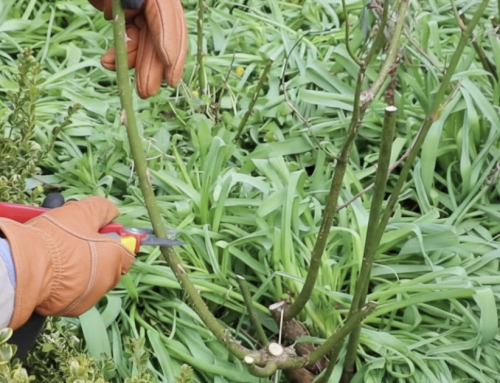
As desccribed above, find the fourth or fifth bud up from the base of the long shoot and using a clean, sharp pair of secateurs cut 3-4mm above the chosen bud Hold the secateurs at the angle to the stem at which the bud is pointing – at around a 30-45 degree angle to the stem. Close the secateur blades swiftly so as to make a clean cut, without tearing the stem.
Repeat for all the vigorous long stems, unless you want to train the growth further to over more the wall, fence or frame that the wisteria is growing on. At the same time look out for and remove any very thin, weak, or misplaced shoots. These are best cut back completely to the main stem which they are growing from. This will stop them crowding the plant or growing away from your support structure.
Avoid cutting into old, woody stems – stick to the soft, green growth that’s appeared this season. In addition don’t cut into any of the short stubby growths. These are known as ‘spurs’ and it is generally these which carry the flowers. Following the pruning routine outlined about should encourage the formation of more of these spurs, and thus more flowers!


Should wisteria be pruned twice a year?
It is a good idea to check over the wisteria in the winter as well, any time after the leaves have dropped in the autumn, and do a little more pruning. Again, avoid cutting back into old wood, simply checking for any long shoots that were missed in the summer, and shortening any regrowth that may have occurred later in the season. Some books and videos suggest shortening all the summer pruned stems back to two buds from the base, but to be honest it can encourage the plant to produce masses of vigorous growth again in the spring.
It is the summer pruning which is essential for helping to tame the growth of wisteria and gradually you’ll find that the plant settles down into a pattern of flowering and relatively little vigorous growth.
Related Posts